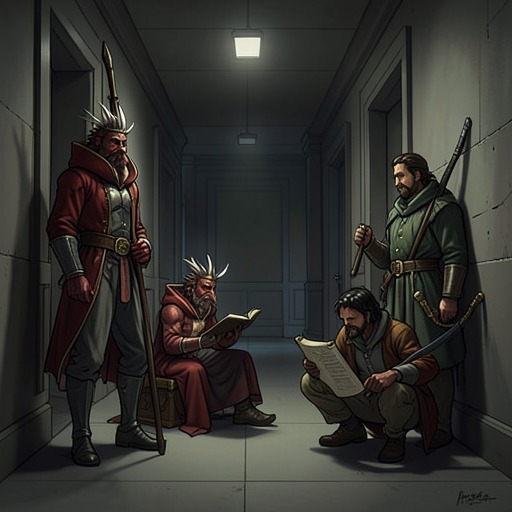
Shining Crusade
Vainqueur the DragonThe Shining Crusade is the militant religious organization of Lord Mithras, identified by its insignia and represented by armed knights who defend the god’s authority through threats, judgment, and force. Its decisive narrative function is to expose the gap between conventional heroic institutions and the morally improvised, treasure-driven adventuring company of Vainqueur Knightsbane and Victor Dalton: the Crusade can denounce Vainqueur as a vile creature, yet later mistake him for villains and finally concede that he belongs to a goodish mercenary type of hero.
Religious Authority and Armed Power
The Shining Crusade appears as an organized body of knights rather than as an abstract faith. When Vainqueur disputes the charges brought against him and insists that his net worth should be corrected to at least one million gold coins, a knight treats the claim as an insult to the god-chosen king of Gardemagne. The knight raises a spear, invokes the Shining Crusade, and threatens that Vainqueur will burn in the fires of Lord Mithras for his pride. The organization therefore combines political loyalty, religious judgment, and military coercion: disagreement with secular authority is framed as an offense against the divine order as well.
The encounter also gives the Crusade a supernatural dimension. As the knights confront Vainqueur, an aura of dread spreads through the area and the weight of the gods’ judgment produces a Terror ailment. The scene presents the organization’s rhetoric as backed by real sacred power, even though that power does not settle the conflict. Vainqueur answers the demand for submission with a demand that the opposing side apologize to him, turning the Crusade’s hierarchy of sin, punishment, and obedience into a comic contest over status.
Encounter with Vainqueur Knightsbane
The Crusade’s most concrete defeat occurs when Victor Dalton leaves an inn and finds roughly two dozen of its knights broken and defeated around the town. The bodies make the settlement resemble the aftermath of a deadly drunken brawl, while the knights’ insignia identifies them as members of the Shining Crusade. Victor had hoped that a knight in shining armor might rescue him; the sight destroys that hope and replaces the traditional image of chivalric protection with an unmistakable scene of institutional failure.
Vainqueur has not merely survived the confrontation. He returns carrying a pile of treasures, including gold purses and magic items, and proudly displays the spoils to Victor. The contrast is central to the Crusade’s portrayal: its knights arrive as representatives of sacred legitimacy, but their defeat supplies Vainqueur with wealth and reinforces his self-image as a victorious dragon. The organization’s religious prestige cannot prevent its armed members from becoming another source of treasure in his hoard.
Conflict with the Adventurer Company
The Crusade exists within a wider system in which Vainqueur and Victor are increasingly recognized as adventurers. After Furibon’s destruction, the adventurer guild recognizes Vainqueur Knightsbane and his human partner as an adventurer company and considers upgrading them to gold-rank, although the politically safer outcome after the Euskal fiasco may be iron or bronze. This institutional recognition places the Crusade’s earlier judgment in ironic opposition to the guild’s classification: the same dragon condemned by militant religious knights is legible to another authority as a professional adventurer whose achievements merit rank.
That contrast is sharpened by the company’s unusual composition and methods. In preparation for the war against Furibon, Vainqueur orders recruitment among monsters, while Victor reports one hundred kobold applicants and additional high-level inhabitants including a troll, a dryad, and a golem. Vainqueur declares that he does not discriminate because all creatures are equally inferior to him and may become emergency food. The Shining Crusade’s conventional opposition between holy knights and vile creatures is thus challenged by a war effort that treats monster mobilization, adventuring, commerce, and conquest as overlapping institutions.
The organization’s world is also displaced by the commercial and infrastructural expansion surrounding Vainqueur’s rule. Victor is ordered to create a shop selling junk, monster parts, and corpses; later, Nethermart opens as a fiendish magic-item shop for monsters and mortals, offering weapons at a thirty percent discount before the coming war with Maure. These developments do not directly describe Crusade policy, but they establish the institutional environment against which it is measured: sacred knighthood is only one competing system of power in a society where adventurers, monster armies, shops, and divine patrons all claim authority.
Reversal and Reclassification
The Crusade’s later response to Vainqueur is markedly less certain than its initial condemnation. After another confrontation, a knight deeply apologizes and admits that she had mistaken Vainqueur and Victor for villains rather than the goodish mercenary type. Victor accepts the apology with surprising warmth, but Vainqueur treats the incident as a debt still requiring payment and demands five griffins as reparation. The organization therefore moves from confident accusation to embarrassed correction, while the dragon refuses to let institutional recognition erase the material cost of having attacked him.
This reversal does not transform the Crusade into an ally. Its apology is practical and defensive, not evidence of a shared program with Vainqueur. The episode instead shows how unstable its moral categories become when confronted with actors who are simultaneously destructive, useful, greedy, and capable of defending a broader cause. Vainqueur may lead a war against Furibon and protect his own followers, yet he remains motivated by treasure and openly describes others as potential food. The Crusade’s difficulty lies in deciding whether such a figure can be heroic without becoming conventionally virtuous.
Narrative Significance
The Shining Crusade embodies the book’s recurring collision between inherited fantasy institutions and the disruptive logic of Vainqueur’s adventurer enterprise. Its knights invoke Lord Mithras, divine judgment, and the Shining Crusade’s sacred identity, but their defeat, their loss of treasure, and their eventual apology undercut the assumption that holiness guarantees competence or moral clarity.
The organization also helps define the story’s satirical treatment of legitimacy. A dragon can be denounced as a vile creature, recruited into an adventurer company, considered for rank advancement, and later recognized as a goodish mercenary hero without ceasing to be Vainqueur. The Shining Crusade’s shifting assessment does not resolve that contradiction; it makes the contradiction visible. In a world where gods trade miracles, souls attract competing afterlife proposals, monsters build institutions, and war is advertised through weapon sales, the Crusade is one powerful organization among many, not the final authority on who deserves the name of hero.